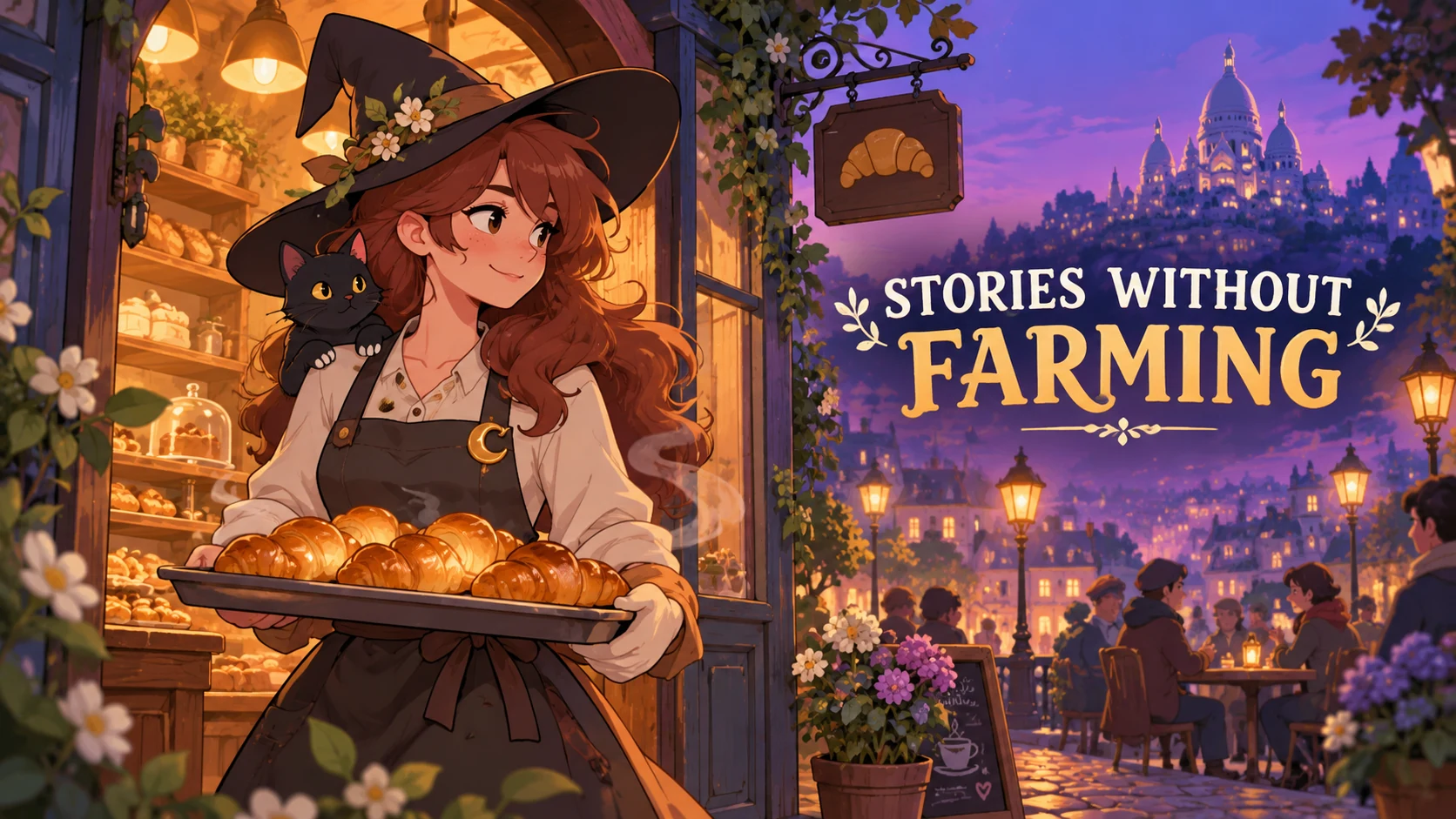
Choose The Witch's Bakery for character-led city life, Duck Detective: The Ghost of Glamping for a compact investigation, Unpacking for a story told through possessions, or Heaven's Vault for language and discovery. These cozy narrative games replace tending a farm with very different kinds of attention. Decide whether you want to read, infer, arrange, or investigate before choosing the evening's story.
I understand the appeal of returning to a village. In Mistria, spending time in town has often interested me more than optimizing the field. Sometimes, though, I want the relationships and atmosphere without another patch of crops waiting behind them.
Pick the kind of story work you welcome
Cozy games without farming can still involve schedules, difficult deductions, or emotionally demanding material. Removing crops changes the activity; it does not automatically make every story light.
Tonight's preference | Start by investigating | What to allow room for |
|---|---|---|
Characters and a magical city | The Witch's Bakery | A structured daily routine and emotional themes |
A focused, funny mystery | Duck Detective: The Ghost of Glamping | Remembering clues and drawing conclusions |
Quiet interpretation through objects | Unpacking | Placement decisions and a personal life story |
A larger world to understand | Heaven's Vault | Reading, language puzzles, and uncertainty |
The first distinction is attention, not total content. A short mystery may ask for more concentration than a longer familiar routine. A text-light game can still carry a great deal of emotional meaning.
I also separate a proposed session boundary from total length. “Investigate one scene” is an intention you can try; it is not evidence that a game will finish in the time before bed.
The Witch's Bakery: choose it for people as well as pastries
The Witch's Bakery puts Lunne, a witch opening a bakery in Paris, at the center of its story. The developer's Steam description explains a daily structure that moves through bakery work, evening exploration and relationships, then nighttime rest and improvements.
That is why I recommend investigating it when the social side of a life sim sounds appealing but the farm does not. A bakery gives the characters somewhere to meet, and the city offers a reason to step outside the work.
The important limitation is that it still contains a routine. Choose it because the bakery and relationships sound enjoyable, rather than expecting a completely unstructured visual novel with nothing to manage.
Its magical premise also deals with people's troubled emotions. The pastry-filled presentation does not establish that every conversation is weightless. Read the official description for the tone you want, and avoid story spoilers while checking whether the subject matter fits tonight.
For a first session, learn the basic work and follow one relationship thread that interests you. Leave the desire to perfect every part of the bakery until you know whether those extra choices are pleasures or distractions.
The three-part day gives you a useful buying question: do you want both the work and the exploration? If only free-form baking appeals, compare the ordinary gameplay with that expectation before buying. The story and relationships are part of the offering, rather than decoration around an unlimited pastry workshop.
Duck Detective: a funny mystery still wants your attention
Duck Detective: The Ghost of Glamping follows a stand-alone campsite mystery built around interviewing, examining evidence, and making deductions. The official page describes its central case as a no-murder mystery.
It belongs here for the reader who wants a defined question to investigate. Compared with an open-ended town, a mystery supplies a clearer reason to talk to someone or inspect a location: you are trying to understand what happened.
That direction can be welcome when deciding what to do in a larger game feels tiring. It can also demand more focused attention than its comic appearance suggests. Clues are useful only when you notice their relationship to one another.
The character premise includes adult difficulties alongside the humor. “No murder” does not mean the story contains no troubled people or uncomfortable moments. Choose it for light presentation and purposeful investigation, with room for its actual themes.
For short cozy story games, remember that a focused case and a tiny session are different claims. Before stopping, leave a spoiler-free note about the current question. That can make returning easier without reading the answers from a walkthrough.

Unpacking: let belongings carry the conversation
Unpacking is the quietest storytelling method in this group. The official description connects moving possessions between homes with discovering the life behind them. You arrange objects and notice what those objects suggest.
Choose it when you want a story without following long stretches of dialogue. A familiar possession can acquire meaning through where it goes next, what surrounds it, or the space it now needs to share.
That does not remove all effort. Placement has rules, and some objects need interpretation before they find a suitable home. If you want completely unrestricted decorating, the puzzle structure can interrupt your preferred activity.
It is also possible to miss the story by rushing to empty every box. Give yourself permission to inspect a small area and notice it. The aim can be settling part of a room rather than pursuing an efficient sequence of placements.
I recommend this kind of storytelling when you want less reading, with the understanding that emotional intensity and word count are different things. A story can speak quietly and still leave something substantial to think about afterward.
Heaven's Vault: for curiosity, with more interpretation
Heaven's Vault is the most demanding choice here for someone seeking a minimal-effort evening. Inkle's description follows archaeologist Aliya and her robot companion through discoveries, relationships, and the translation of an ancient language.
My recommendation is conditional on enjoying interpretation. The appeal is taking a clue seriously, considering a meaning, and building an understanding of the wider world. That can be absorbing when you want something richer than another routine, and tiring when you have already spent the day making difficult decisions.
The story responds to choices and discoveries, and an uncertain translation is part of the experience. Do not approach it expecting every inference to be immediately confirmed by a simple correct-answer screen.
For a returning session, keep a short note about the person, place, or inscription you are considering. Preserve the question in your own words rather than copying a large list of future objectives. Understanding the current thread matters more than keeping a perfect archive.
This is a world to investigate when curiosity sounds restful. If you want a story that asks very little of you tonight, choose another row in the table instead of making this recommendation fit by ignoring its central activity.

Check language, text, and your stopping place
When comparing the best story games on Steam, inspect the supported language and actual text before buying for a small screen. Voice acting does not establish that every important clue is narrated, and a story-rich tag does not explain how comfortable a menu will be on Deck.
Check the edition and platform you intend to use. The linked pages establish PC product information; they do not promise the same controls, features, or performance on every console.
Saving also belongs in the story decision. Learn the available save process early, and avoid planning an exact twenty-minute ending around an unknown checkpoint. A good narrative stopping place and a completed save are related questions, not identical ones.
Leave a little attention for returning, too. If you expect several days between sessions, a character-heavy mystery may benefit from one short note about the current question. A story told through objects can offer a more visual reminder, while an unfamiliar language may ask you to reconstruct more context. Choose the return you welcome as well as the opening that attracts you; the second evening is part of the experience you are buying.
Choose the next question you want to follow
For cozy story games, I start with curiosity: whose situation do I want to understand, or what place do I want to investigate? That gives the session a purpose without requiring another production plan.
Choose one title from the table and read its ordinary activity alongside its remaining demand. If the bakery, mystery, room, or inscription sounds appealing even after that check, you have a reason to begin. Let the story supply tonight's direction, and leave the farm for another evening.