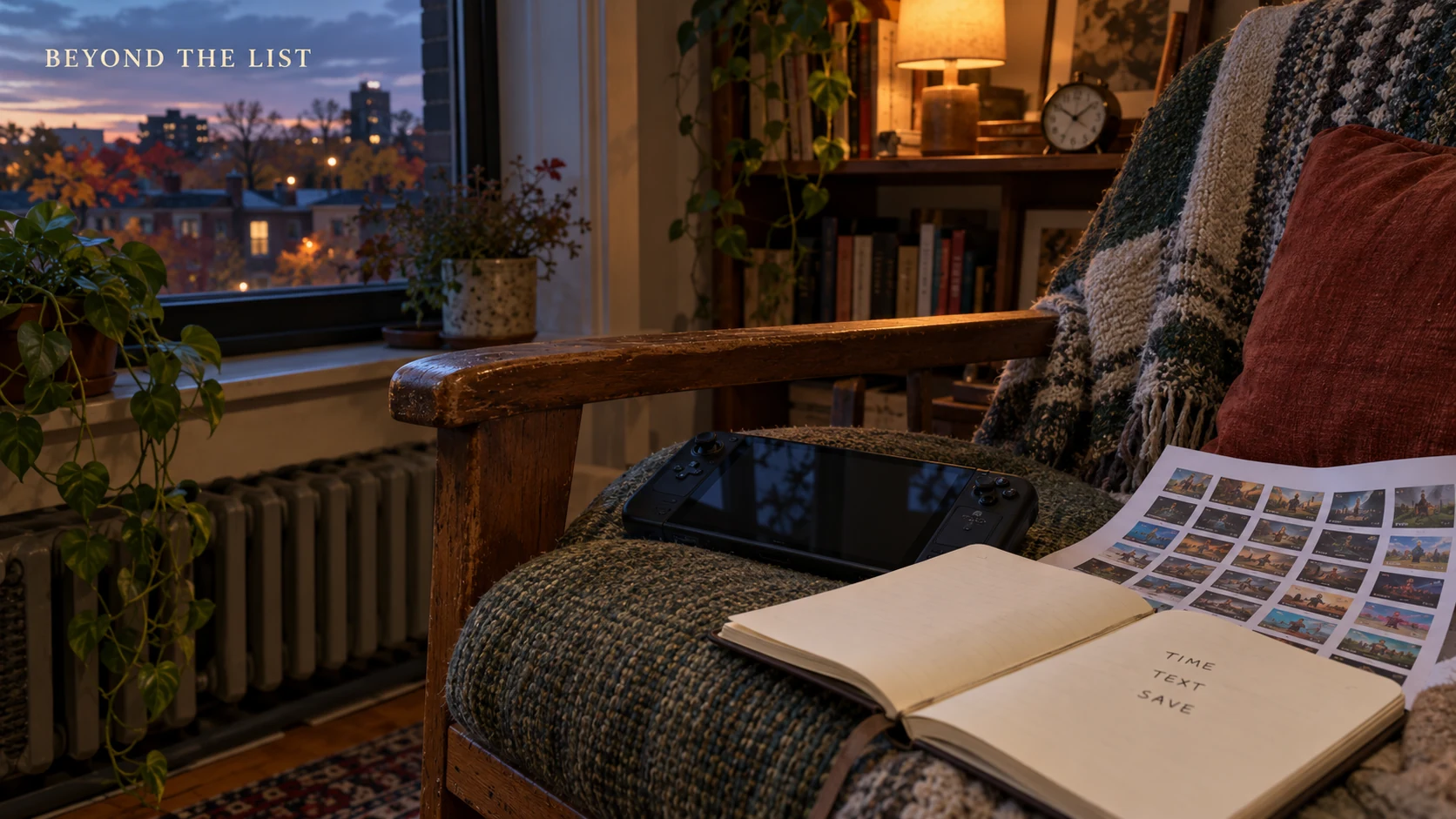
A useful cozy game guide should tell you whether a game fits the evening you actually have: your time, your energy, and the device in your hands. A list of beautiful worlds rarely answers whether you can stop after twenty minutes or read an order without leaning toward the screen. Those are the details I built Cozy With Context to explain.
I enjoy discovering something lovely in a long recommendation list. The trouble begins when discovery is treated as the whole decision. Twenty-five appealing games can leave you with twenty-five store tabs, a larger wishlist, and no clearer idea of what to play tonight.
My starting point is smaller: what kind of play makes sense for you now? Sometimes that means a farm. Sometimes it means cleaning one wall. Sometimes the right answer is leaving a promising new release on your wishlist until you have the patience for it.
The cozy part can disappear between the screenshot and the sofa
Dressmaker gave me a particularly clear example. After its September release, I downloaded it on my Steam Deck and spent an evening cutting fabric with cinnamon tea nearby. I loved the soft scrape of the scissors and the pleasure of making something take shape.
About forty minutes in, the tiny order text and color labels were getting in the way. I was leaning closer to read them. The fabric was lovely; my neck was less impressed.
Using the magnifier and moving fine pointer work to the right trackpad made the controls more comfortable for me. That adjustment belongs in a recommendation. It changes the answer for someone choosing between a handheld screen and a monitor, especially when small text is already a nuisance.
A screenshot can show the dress. It cannot show how often I needed to inspect a label, how my thumb felt, or whether I wanted to keep holding the device. A useful guide brings those less photogenic details into the buying decision.
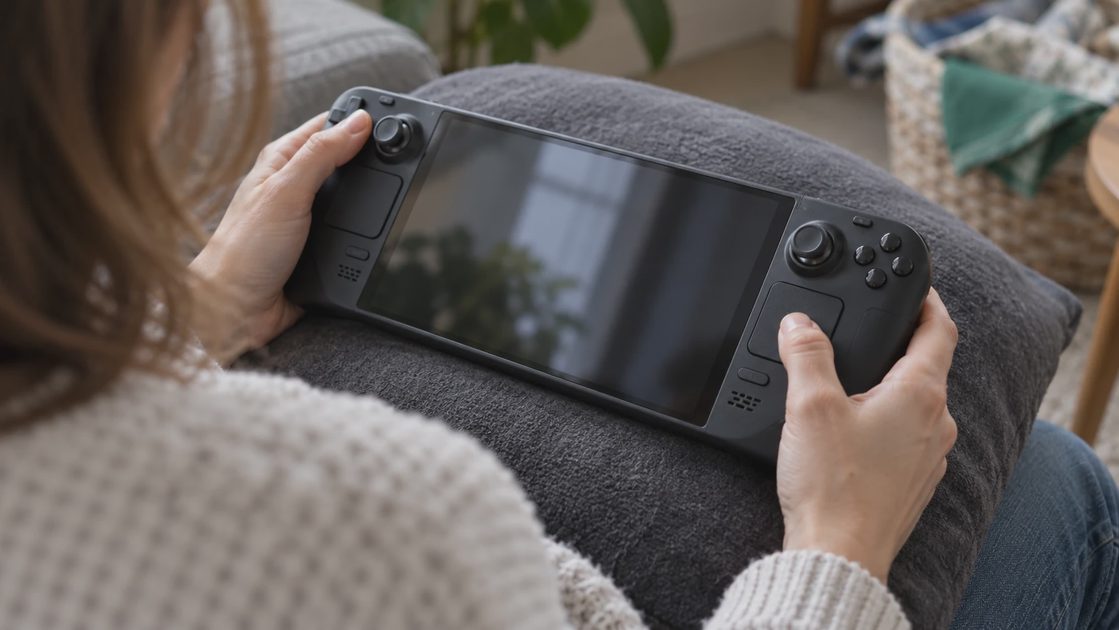
That also means separating a game's design from the way a particular setup delivers it. A gentle activity can become tiring through awkward controls. An absorbing game can feel easier once the screen is readable. Neither observation requires declaring the game universally good or bad.
“Relaxing” needs a little more explanation
I use cozy as a starting description. Before recommending a game, I want to know what it asks you to tolerate.
There is a difference between a timer that ends a harmless round and a timer that destroys your progress. There is a difference between optional combat and a fight you must finish to reach the next area. And there is a difference between choosing to visit a town every evening and feeling obliged to maintain it.
PEAK is a useful boundary case. Climbing with friends gave me the kind of laughter that makes a failed attempt part of the evening's entertainment. Alone, I found the same climbing much more frustrating. Its official description makes the risk of mistakes explicit. I can recommend it for a particular social mood while passing on it as a quiet solo game before bed.
Stardew Valley presents a different tension. Planting a few crops can be a pleasant ritual. Planning an entire production system can also be satisfying, but it asks for more attention. My own enjoyment of Fields of Mistria has included simply spending time in town, rather than treating every available moment as a chance to increase output.
That is a preference about how I play. It does not make one game's clock objectively slower or mean another player cannot enjoy an efficient farm. A useful guide explains the systems and the suggested approach so you can decide how much structure you want.
Twenty minutes should lead to a stopping point
When I call something suitable for a short session, I mean more than “you can close it after twenty minutes.” You can close almost anything. The question is what you leave behind.
I look for a small activity that feels complete, a practical way to preserve progress, and enough context to return without reconstructing a complicated plan. Those are separate requirements. A game can satisfy two and still struggle with the third.
My evening check-ins with Pokémon Pokopia have become a fifteen-minute ritual: return to the town, see what has changed, and choose something small to do. That experience is useful because it shows how I fit the game into my evening. It does not prove every construction project, early tutorial, or online session fits the same window.
Cozy Grove: Camp Spirit offers another kind of rhythm. Its story unfolds with real-world days, and I appreciate having a day's story tasks come to an end. The developer also explains that fishing, crafting, collecting, and decorating remain available afterward. I can use the story boundary as permission to stop without pretending the game switches itself off.
Here is the distinction I want a guide to make before you buy:

Your available evening | What to check | What makes me hesitate |
|---|---|---|
About 20 minutes, with a firm stop | A small task and a clear way to save | A lengthy introduction or progress saved only after a larger commitment |
30–60 minutes, with room to get absorbed | A satisfying loop and a manageable next step | Several systems competing for attention before the enjoyable part begins |
Time with friends | Group size, coordination, and how failure feels together | Calling a demanding cooperative game relaxing without explaining the group dynamic |
Very little appetite for decisions | Familiar actions and modest immediate goals | Choosing a supposedly gentle game that still needs substantial planning |
These are questions to apply to a game, not promises about an entire genre. A farming sim can fit a short evening once its routine is familiar. A puzzle can take longer than expected. I want that context beside the recommendation.
Your platform changes the recommendation
For Steam Deck, I care about legible text, comfortable controls, performance, and what happens when a session is interrupted. For Switch 2, I still want the exact edition and play mode identified. A desktop review does not automatically answer either set of questions.
Valve's Deck compatibility program is a useful first check. Verified and Playable describe different levels of compatibility; Playable may require adjustments. I still want a guide to explain the relevant detail, such as small text or a control change, instead of making the badge carry the whole recommendation.
My friction notebook is for those details: the menu that takes too many steps, the pointer that feels better on a trackpad, the setting worth changing before the first proper session. A useful note connects the problem to an action. “Handheld controls are awkward” leaves you guessing; identifying the uncomfortable action and the adjustment gives you something to try.
The limits matter just as much. I will distinguish a recorded observation from an estimate and identify the device and settings when reporting performance or battery results. A number without that context is difficult to use. “Runs well” also needs an explanation of what went smoothly and what still got in the way.
Sometimes the practical recommendation is a different screen. Sometimes it is a lower frame-rate target or simpler graphics. Those are ordinary tradeoffs, and knowing about them before buying is part of the service.
A sale price still needs a reason to buy
Years spent analyzing product pages and prices left me wary of treating a discount as a recommendation. A lower price helps only after the game clears the more important question: do you want the experience it offers?
For this site, I use four buying judgments:
Buy Now: The game fits the reader described, and its current offering justifies the price.
Wishlist: There is a promising fit, but more information, an update, or a different mood could change the decision.
Wait for a Sale: The appeal is clear, but the present price or remaining friction makes waiting sensible.
Not the Right Kind of Cozy: Its demands conflict with the kind of rest the reader is seeking.
These judgments need reasons attached. A mechanically demanding game can earn enthusiastic reviews and still be a poor choice for someone who wants gentle solo play. A short game can justify its price if the experience is exactly what you want. Neither decision becomes clearer by dividing the price by the largest imaginable playtime.
Waiting also has a cost: you do not get to play the game now. That matters when a new release fits your interests particularly well. My job is to explain the tradeoff, including the reason to wait, rather than making every purchase sound urgent or every full-price purchase sound foolish.
A beginner guide should make your first evening smaller
Recommendations are only the beginning. After buying a game, it is easy to search for help and encounter a schedule optimized by someone with hundreds of hours of experience.
That schedule may be excellent for its intended reader. It can also turn a first evening into a list of things you have already done incorrectly.
I prefer a smaller route: learn the controls you need, find out how progress is saved, choose one useful goal, and identify what can wait. For my approach to Pokopia, that means starting with a small area instead of designing the whole town at once. In a farming game, it means resisting the urge to give every bit of land a job immediately.
There is room for detailed advice here. I want to explain which early action removes a recurring annoyance, which system unlocks something important, and which apparently urgent task is optional. The distinction should come from the game, not from a blanket instruction to ignore all goals.
Your First Quiet Week is built around that kind of help. Set It Softly handles the device friction. Before You Buy handles the purchase. The Cozy Shortlist helps you choose an experience. Together, they should take you from curiosity to a comfortable first session without demanding that you become an expert first.
Start with the detail that usually spoils the evening
I still want this site to help you discover games you have never heard of. I also want a recommendation to remain useful after the screenshots have done their work.
That means telling you about the tiny text beside the beautiful fabric, the coordination behind the funny climbing video, and the point where a peaceful routine starts asking more of you than you want to give. A good guide makes those demands visible early enough for you to choose.
Before opening another store page, finish this sentence: “Tonight I have ___ minutes, and I do not want to deal with ___.”
Use the second blank to check the next recommendation you read. It might be combat, tiny text, repetitive collecting, or the effort of coordinating with friends. If the guide answers that concern, it has helped you make a decision. If it leaves you guessing, a longer list will not solve the problem.