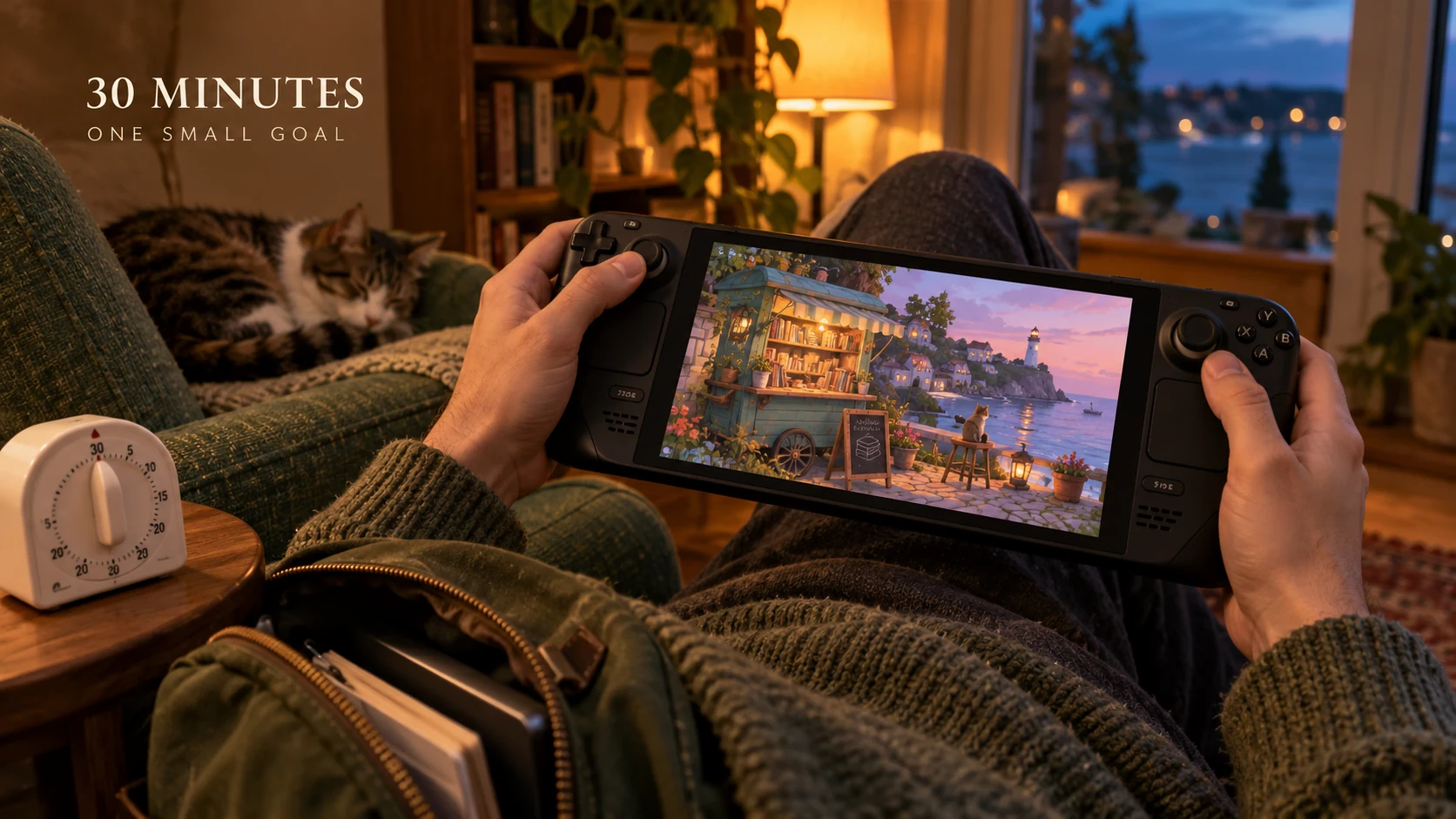
For a firm half-hour break, I recommend Unpacking for quiet arranging or A Little to the Left for small puzzles. Tiny Bookshop suits an evening with room for reading, while PowerWash Simulator 2 works best when you can leave a larger job unfinished. Fields of Mistria is my pick when you want a familiar farming routine and can resist adding three more errands.
The best cozy games on Steam Deck give you something satisfying to do and a reasonable place to stop. That second requirement matters when tomorrow starts early. These five recommendations are organized around the kind of evening you have, with a small goal and a reason to choose something else.
Choose the evening before choosing the game
“Thirty minutes” below is a suggested play window, not a measured completion time. A first launch, tutorial, or unfamiliar control scheme can take longer than a settled routine.
Tonight you want… | My pick | A small goal | The catch |
|---|---|---|---|
Quiet arranging | Unpacking | Settle one corner of a room | Some objects have placement rules |
A clear little finish | A Little to the Left | Solve a few puzzles | The intended pattern can be elusive |
Gentle decisions and conversation | Tiny Bookshop | Make a few book recommendations | Reading and stock choices need attention |
Repetitive, visible progress | PowerWash Simulator 2 | Clean one distinct section | A whole job may need several evenings |
A town to return to | Fields of Mistria | Tend crops and visit someone | The clock and optional activities can pull you onward |
These are cozy Steam Deck games for adults with limited evening time, rather than a ranking of which game offers the most hours. More content is useful only when you enjoy the minutes in front of you.
Unpacking: for an evening with fewer words
Unpacking tells its story through possessions: the books someone keeps, the objects that follow them, and the space available in a new home. Its official Steam page describes the combination of arranging belongings and discovering a life through them.
I recommend it when you want a tactile activity without a shopping list of upgrades. Choose a corner, make it feel settled, and leave the remaining boxes for another session. Completing an entire move is a bigger commitment than putting away a few objects.
There is still a puzzle underneath the tidying. Objects do not always belong wherever you first put them, so a nearly finished room can require more thought than the opening boxes suggest. If discovering the correct placement sounds irritating tonight, choose a game whose activity feels good before anything is completed.
On the Deck, the useful question is whether placing a small object feels comfortable. Start with the default controls; if fine positioning becomes fiddly, compare the trackpad with the stick before abandoning the game. That is a comfort check, not a requirement to install a community layout.
A Little to the Left: for a satisfying stopping point
Sorting household objects into patterns gives A Little to the Left a useful advantage: the next task is usually easy to describe. Arrange this collection. Notice that relationship. Stop after a solved puzzle instead of opening an entirely new project.
For short cozy games on Steam Deck, that structure matters more to me than total campaign length. A long game with small, distinct puzzles can fit an evening better than a short story with an awkward interruption point.
The frustration comes when your tidy arrangement and the puzzle's intended logic disagree. The developer's Steam description confirms adjustable hints and the “Let It Be” option for skipping a level. Use them. Solving every variation tonight is an optional challenge.
My suggested boundary is simple: finish a few puzzles, then return to the menu before starting another. If a puzzle feels like an argument with a drawer organizer, skip it or switch games. A daily puzzle can be a pleasant invitation without becoming an appointment.
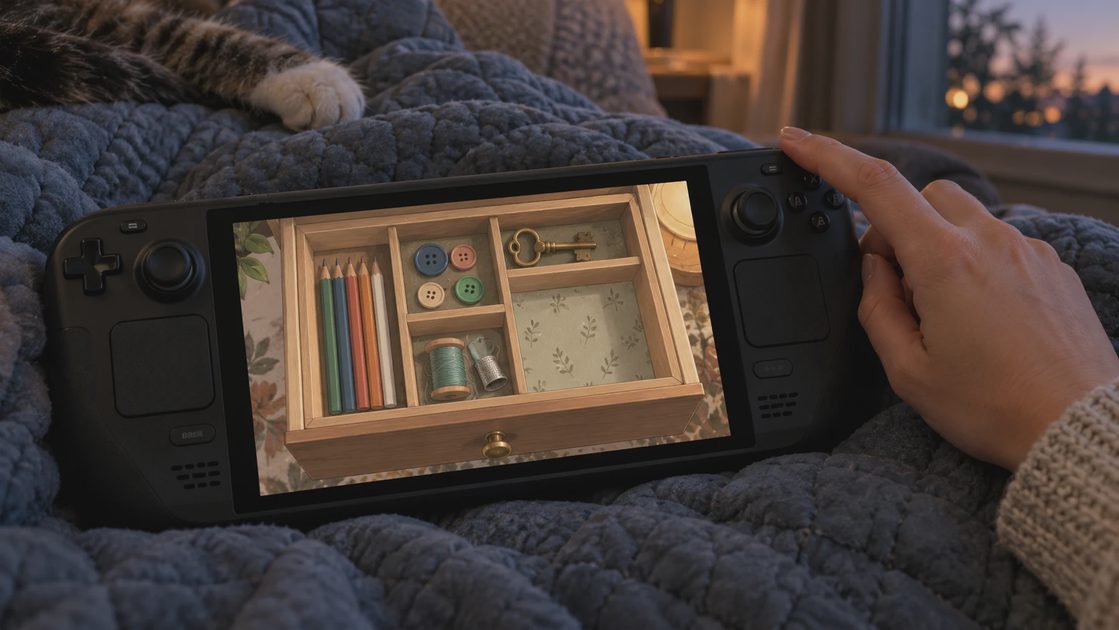
Tiny Bookshop: when a little thinking feels welcome
Tiny Bookshop asks you to stock a traveling secondhand bookshop, match books to customers, decorate, and get to know a seaside town. The official description makes those management and conversation elements clear.
I enjoy the small satisfaction of handing someone a book rather than rebuilding an entire economy. That makes this a good choice for the evening when you still want to make decisions, just gentler ones than the day required.
The distinction matters: this is not my recommendation for avoiding all reading or inventory choices. Customer requests ask for attention. Decorations also affect the shop, so an attractive arrangement can become another optimization project if you let it.
Keep the first goal narrow. Learn the bookselling loop before redesigning the whole cart, and use the available demo to check whether requests are comfortable to read on your screen. The developer's Deck update added zoom for speech-bubble text. Try that before deciding the screen is too small. The enjoyable routine needs to survive the move from a monitor to your lap.
Among cozy Steam games, this is the pick for a little community and a useful task. Leave it for another night when even a short conversation feels like too much input.
PowerWash Simulator 2: when progress is enough
Some evenings, deciding what to plant feels like an unreasonable request. Cleaning a dirty surface gives me a simpler pleasure: one visible patch becomes clean, and that small change is enough.
PowerWash Simulator 2 offers that repetitive loop, with solo play as well as cooperative options. Its Steam page also describes multi-stage jobs, which is a useful warning against treating each assignment as a half-hour activity.
Pick a boundary you can see: a set of steps, one wall, or a section of a vehicle. Finish that section and stop. The larger project can remain unfinished without erasing the pleasure of what you cleaned.
I recommend trying the demo on the Deck before buying. Check the feel of aiming, camera movement, and the fan noise you tolerate in a quiet room. A compatibility badge cannot decide whether those sensations suit your evening.
This is a weaker fit if an incomplete percentage keeps calling you back. For that mood, I choose the discrete puzzles above. The cleaning is gentle; your completion rule determines whether the session stays small.
Fields of Mistria: for a routine you can keep modest
Fields of Mistria is a farming and life sim with town relationships, crafting, and exploration; NPC Studio confirms Steam Deck compatibility. I include it for players who want a place to revisit, rather than a sequence of isolated tasks.
My favorite part has been spending time in town without converting every spare moment into farm output. A modest crop patch and a visit give the evening a shape. They also leave things undone, which is the point of this recommendation.
There are important limits. An in-game clock still structures the day, and the mining and adventure side includes combat. Choose the arranging or puzzle options when either feature is an immediate deal-breaker.
For a half-hour session, set one farm task and one social goal before starting. Treat deeper mining, stockpiling, and large redesigns as separate plans. Mistria earns its place here through a manageable routine, not a promise that its systems cannot become demanding.
Check how stopping works on your Deck
Lists of the best cozy games on Steam often end at the recommendation. I also want you to know what happens when real life interrupts.
Valve's compatibility criteria cover controls, display, and other technical requirements for Steam Deck Verified games. They do not guarantee that you will like the text size, finish a task in thirty minutes, or find the save system convenient.
For cozy games with easy save systems, check these things during your first short session:
Make a small, recognizable change. Finish a puzzle or move an object.
Use the game's save or normal exit process. Check the menu and any confirmation rather than guessing.
Reopen once. Confirm what persisted before relying on that stopping point.
Suspend is useful for interruptions, but it is not a substitute for a saved game. When moving between PC and Deck, finish the save and let Steam Cloud sync before starting elsewhere.
For Steam Deck games for 30-minute sessions, make tonight's goal smaller than the game's goal. Choose one row from the table, check the stopping point, and play that small piece. Leave the next piece for tomorrow.